
Cannabis Laws by Australian State
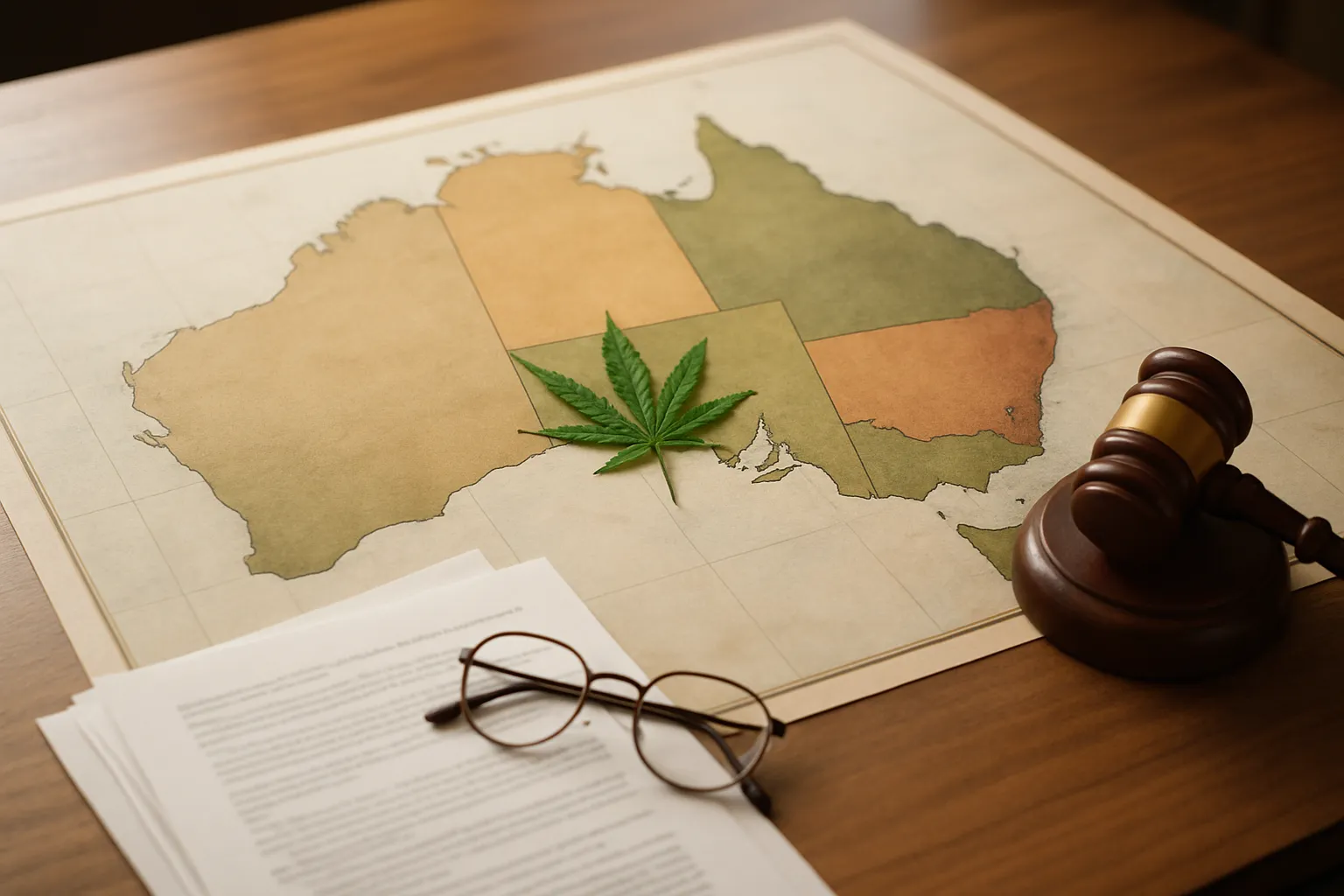
Understanding Cannabis Laws by Australian State is essential if you live in, work in, or are visiting Australia. Rules differ significantly between jurisdictions, and what is legal in one place can still be a criminal offence in another. This guide walks through each state and territory, explains key differences, and highlights the practical risks you should be aware of.
Why Cannabis Laws by Australian State Differ
Australia does not have a single, unified cannabis law. Instead, each state and territory sets its own rules on:
- Possession of small amounts for personal use
- Growing cannabis plants at home
- Supplying, selling, or trafficking
- Use of medicinal cannabis products
- Drug driving and workplace drug testing
Federal law still treats cannabis as an illegal drug, especially for import, export, and large-scale trafficking. However, day-to-day enforcement for personal use is mostly governed by local legislation.
Cannabis Laws by Australian State and Territory
Australian Capital Territory (ACT)
The ACT has the most liberal approach to personal cannabis use in Australia, but it is not a free-for-all.
- Possession: Adults (18+) can possess small amounts of cannabis for personal use, within specified limits.
- Home grow: Adults can grow a limited number of plants per person and per household. Hydroponic setups and artificial cultivation methods may be restricted.
- Supply and sale: Selling, sharing large quantities, or trafficking remain criminal offences.
- Public use: Using cannabis in public places is still prohibited.
Importantly, federal law still applies in the ACT, so there is some legal tension, especially around supply and larger quantities.
New South Wales (NSW)
NSW maintains a largely prohibition-based model, but with some diversion options for minor offences.
- Possession: Small amounts for personal use remain illegal. Police may issue a caution for first or minor offences instead of prosecution, at their discretion.
- Home grow: Cultivating cannabis plants is generally a criminal offence, even for personal use.
- Supply: Supplying or trafficking attracts significant penalties, which increase with quantity.
NSW operates a cannabis cautioning scheme, but it is not a right; it depends on police assessment of your circumstances and prior record.
Victoria
Victoria has decriminalised some aspects of personal use, but cannabis remains illegal.
- Possession: Small quantities may lead to a caution and referral to education or treatment programs rather than court for first-time offenders.
- Home grow: Growing cannabis plants is generally illegal without a medical or research licence.
- Supply: Significant criminal penalties apply for dealing and trafficking.
Victoria was an early adopter of regulated medicinal cannabis, but this does not legalise recreational use.
Queensland
Queensland has traditionally taken a strict approach to cannabis.
- Possession: Any amount is illegal. For minor first offences, police may offer diversion to assessment or education rather than prosecution.
- Home grow: Cultivation is treated as a criminal offence, with penalties scaling up with the number of plants.
- Supply: Strong penalties for supply, especially near schools or to minors.
Recent reforms have focused on medicinal cannabis access, not on legalising recreational use.
Western Australia (WA)
WA previously had civil penalties for small amounts but now applies a stricter regime.
- Possession: Still illegal; police may issue a cannabis intervention requirement for minor amounts, directing you to education sessions.
- Home grow: Growing plants without a licence is an offence.
- Supply: Heavily penalised, with higher penalties for commercial quantities.
South Australia (SA)
South Australia is relatively lenient for small-scale personal use.
- Possession: Small amounts for personal use can attract an expiation notice (similar to a fine) rather than a criminal record.
- Home grow: A very small number of plants for personal use may also be subject to expiation rather than prosecution, depending on circumstances.
- Supply: Commercial cultivation and supply remain serious criminal offences.
Tasmania
Tasmania retains criminal penalties but has some diversion options.
- Possession: Small amounts are illegal; police may offer diversion to education or treatment, particularly for first offences.
- Home grow: Cultivation is generally prohibited.
- Supply: Dealing and trafficking attract substantial penalties.
Northern Territory (NT)
The NT has a mix of criminal and infringement-style responses.
- Possession: Small amounts may result in fines rather than a criminal record, but larger quantities carry heavier penalties.
- Home grow: Growing plants is typically an offence without authorisation.
- Supply: Strong penalties for supply and cultivation of larger crops.
Medicinal Cannabis and Drug Driving
Across Australia, medicinal cannabis is legal under strict conditions, usually via prescription and through approved products. However:
- Having a prescription does not automatically protect you from drug driving laws.
- Roadside tests in most states detect THC, not impairment, and penalties can apply even if you are using prescribed products.
- Workplaces may still enforce zero tolerance policies, particularly in safety-sensitive roles.
Key Takeaways and Staying Safe
- Laws vary widely between states and territories, especially for possession and home growing.
- Supply, trafficking, and large-scale cultivation are serious offences everywhere.
- Medicinal cannabis is regulated separately and does not legalise recreational use.
- Drug driving laws are strict and often apply regardless of medical status.
Always check up-to-date local legislation or seek legal advice before making decisions about cannabis use or cultivation in Australia.
Conclusion: Understanding cannabis laws by Australian state helps you avoid unintended offences and navigate a complex, evolving legal landscape. While some jurisdictions are moving toward more lenient treatment of personal use, cannabis remains tightly controlled nationwide, and penalties for supply and impaired driving are severe.